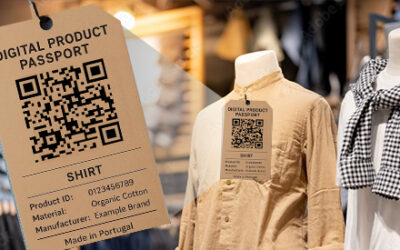
Symbols containing data read electronically is an innovation now three quarters of a century old. However, the use and functionality of bar codes continues to grow almost expontentially as time goes on. What started as simple lines and spaces to identify products has evolved into a critical part of logisitics and continues to grow in function and complexity looking ahead.
Moving Into The Next Dimension
Over the last 30 years, there has been an increasing need for more data to be shared and stored. Initially starting with the 12-digit UPC product code for point-of-sale, then growing to larger and more complex containers and material labels containing numerous linear bar codes – each had to be scanned for information like part numbers, serial numbers, product quantity, etc.
This led to the creation of two-dimensional bar codes or symbols that can encode much more data into gridworks, or multi-scan patterns as opposed to a single line of bars and spaces. Now, multiple pieces of information could be encoded into a smaller symbol and provide data redundancy, all in a single scan.
To create and maintain barcode standards across large industries and various systems, there needed to be a unified standard for what data would be encoded and how. This need for a uniform standard would lead to the creation of GS-1.
What is GS-1
The GS-1 organization develops and maintains international standards for bar codes and company identification prefixes. Originally founded as the UCC (Uniform Code Council) in 1974, the industry group administrated the newly developed UPC (Uniform Product Code) standard for point-of-sale product labeling and assigned Company Prefixes to member organizations who, in turn, assigned Product IDs to each over-the-counter item.
Two years later, the EAN (European Article Numbering Association) was created to develop an international standard for product labeling in 12 countries.
In 1990, the two organizations signed a cooperative agreement and expanded to 45 countries world-wide. By 2005, that number had more than doubled to over 90 nations and fully adopted the name GS-1 on a global basis.
While the name has changed, the functions of GS-1 have stayed relatively the same as well as developing additional industry standards for RFID (Radio Frequency Identification) under the EPC banner.
In the 50 years since its founding, the organization has also been at the forefront of developing new methods and systems for improving the supply chain as the needs are increased for more detailed information.
What is Sunrise 2027
Recently, GS-1 has announced the next major transition in bar coding standards, but also standards regarding point-of-sale devices. Sunrise 2027 will oversee a shift from traditional linear bar codes (UPC-A and GTIN-14) into two-dimensional bar codes (QR Code and Data Matrix) to meet the rising need for more detailed information beyond just product and company identification.
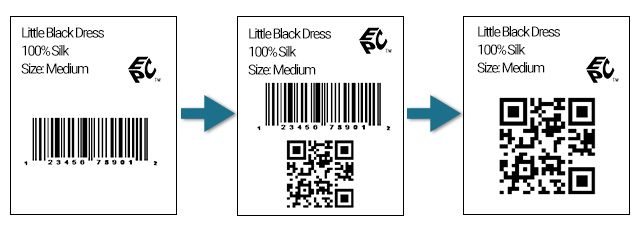
This will require store check-out lanes to universally support these symbols, and more companies will need to incorporate them into their products. There will be a transition period with retail items having both liner and two-dimensional symbols as the program unfolds.
The evolution has already been slowly coming. But there will still very likely be a ripple effect in the supply chain as those manufacturers, transportation companies and retail outlets that have not been taking the needed steps to move away from linear barcodes will now have to take the leap forward.
Bar Coding in Two Dimensions
Most people are accustomed to seeing the QR Code symbol, which can even contain web links as well as potentially hundreds of bytes of information and easily scanned from a distance or right off a video screen.
Other two-dimensional symbologies like the PDF-417 (Portable Data File) and the UPS Maxicode have already seen wide acceptance in specific industries. Manufacturers, particularly AIAG and Odette automotive groups, the U.S. Department of Defense and shipping companies like Fed-Ex quickly adapted the PDF-417 for use because of its capability to encode over 2,000 bytes of data, including image files.
In the case of the automotive industry, the AIAG (Automotive Industry Action Group) created a standard that includes supplier information, part information, quantity, weight, dock location, line location, manufacture date, and unique container number all in a single symbol that can be scanned and then populate a data record in seconds.
For GS-1. there was a need for more than just the simple Point-of-Sale symbologies (UPC-A / GTIN-12 and UPC Container / GTIN-14 barcodes) that provided only the name of the manufacturer and the product ID, but able to print as small or smaller than the current symbols.
Symbologies like the QR Code and Data Matrix allow for greater flexibility, more data content, and can take up notably less space on product labels, while maintaining a high readability factor.
Data Matrix, which can contain over 1,000 bytes is also versatile enough to be encoded at very small sizes or even imprinted directly into material like plastic and metal while still being easily readable. This can eliminate the need for paper labels in extreme environments as well as add product part traceability into the manufacturing process.
QR Codes have already become ubiquitous in our everyday lives, appearing in magazines, billboards, concert tickets, etc. They appear as a more modern barcode most consumers can easily recognize and can access from their personal devices.
Part of the Sunrise 2027 transition is the addition of QR Code and Data Matrix symbols onto existing product packages alongside UPC-A barcodes. By 2027, nearly all Point-of-Sale items will have a 2d symbol replacing or in addition to the UPC-A / GTIN-12 symbol. As well as all Point-of-Sale systems are expected to be able to read those 2d symbols and incorporate the additional data they would carry.
Static vs. Dynamic Data
So, what kind of additional data is to be added to these new QR Code and Data Matrix symbols?
Currently, the UPC-A / GTIN-12 contains only two pieces of information. The Company ID and the Product ID for traceability. And that data is static. That means, no matter how many cans of Libby’s Cut Green Beans, it’s always the same data. The barcode tells you Libby’s made it and it’s a can of cut green beans.
But what if you need to know more? Which batch or lot was the can from? When was it made? Is there an expiration date? That’s where Dynamic Data comes into play.
A QR Code or Data Matrix symbol with this additional information would be printed on the product during packaging. The Point-of-Sale register will still tell you how much that can of greens beans costs, but if it was badly made or damaged in shipment then the store or shipper could trace it back.
Imagine scanning a food product that has expired, and the register suddenly flashes an alarm, telling you not to buy it because the barcode data shows it has passed its perishable date.
QR Codes have already become ubiquitous in our everyday lives, appearing in magazines, billboards, concert tickets, etc. They appear as a more modern barcode most consumers can easily recognize and can access from their personal devices. Part of the Sunrise 2027 transition is the addition of QR Code and Data Matrix symbols onto existing product packages alongside UPC-A barcodes.
By 2027, nearly all Point-of-Sale items will have a 2d symbol replacing or in addition to the UPC-A / GTIN-12 symbol. As well as all Point-of-Sale systems are expected to be able to read those 2d symbols and incorporate the additional data they would carry.
What Does This Mean For You?
As Sunrise 2027 phases out traditional one-dimensional symbols like the UPC-A Point-of-Sale barcode and the EAN-13 (European Article Numbering) symbols in favor of QR Code and Data Matrix, the new standard will allow for much more information with details like:
- nutrition
- materials
- ingredients
- safety information
- country of origin
- allergens
- recall alerts
As a manufacturer, it means adding these symbols to products and containers. And if these symbols are used to direct a customer to a company web site, detailed product information would need to be available. Opportunities exist for companies to provide support for customers directly with things like recipes and suggestions for food items, source information and manufacturing details for socially conscious customers, and options like How To videos or online assistance for things like electronic or household items. Such attention to detail can result in increased customer satisfaction and up sales.
For the retailer, this means ensuring that Point of Sale systems support the two-dimensional bar codes just as they support traditional GTIN-12 (UPC-A) symbols. By 2027, scanners should be able to not only read these symbols but incorporate the added dynamic data.
GS-1 and T.L. Ashford
Both T.L. Ashford’s Barcode400 and TLAForms software packages fully support the most popularly used two-dimensional symbologies (QR Code, Data Matrix, PDF-417 and UPS Maxicode).
Adding one to your label design or form is as easy as clicking on which symbol you need, adding your needed data from your IBMi and drop in place.
T.L. Ashford & Associates has also been fortunate to work directly with industry leaders, when it comes to implementation of two-dimensional bar code standards. We regularly aid users to meet industry bar code standards and their customers’ labeling requirements.
Our team is happy to go above and beyond, not just supporting the software, but helping in the compliance label approval process. Our support department maintains a library of thousands of templates for over 500 companies worldwide. We continuously get updates of label requirements and specifications to keep our templates accurate and current.
The T.L. Ashford & Associates software and support team will be ready to help when the sun rises in 2027 for GS-1’s bold initiative forward.